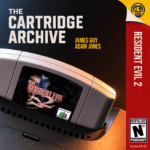

Resident Evil 2 Transcript
[00:00]
Welcome to the Cartridge Archive, the show dedicated to chronicling the complete Nintendo 64 library
one cartridge at a time. I’m Jamie. And I’m Adam. Each episode, we pull another game from the shelf
and explore its impact on Nintendo 64 history.
[00:30]
From beloved classics and hidden gems to forgotten curiosities and infamous disasters, no cartridge
is left behind. And along the way, we’ll examine each game’s story, development, legacy, collector
value, and the impact it left on the Nintendo 64’s library as a whole. Then we will put it through
the rigorous and totally patented 64-point inspection to determine whether it has what it takes to
become certified 64. Gotta make it spooky.
[01:00]
Oh, gotta make it spooky. It is spooky season. It is for Halloween-ish, because I’m not sure exactly
where this falls, but it’s sometime this month. We decided we’d do a scary game, and this is one of
the scarier ones on the platform. Yeah, for sure. And for clarification, we are recording these out
of order and ahead of time. Adam is very much aware when Halloween falls. He just doesn’t know when
this episode falls relative to Halloween. Just in case you thought he was a fucking idiot there for
a second.
[01:30]
I’m sure plenty of people do think that, but I think we are… It’s within a week of Halloween.
That’s all I remember. I don’t think it’s on the actual day, but I think it’s fairly close. Yeah,
close enough to feel in the spirit of the season anyway. I like the idea. Maybe this is something we
can carry over in the future, where our quote-unquote Halloween episode each year is, pick one of
the spookier games in the library, or a darker one, or one that we find terrifying, like War Gods.
[02:00]
But, you know, we could… There’s quite a few. I mean, you know, we can just throw out a couple of
names now, thinking about it, but, like, there’s Shadow Man and Nightmare Creatures. Yeah, yeah.
Yeah. So, I think Resident Evil’s a really good pick to start it off, though, because this game is a
very well-known title beyond the Nintendo 64. And, of course, compared to those other two, it’s got
certainly more of a relevance compared to those games. Yeah, it’s got some cachet. It’s got some
cachet. We don’t want to burn all the big hitters as far as the games that we’re covering on just
the first season of this podcast,
[02:30]
but I think this is one that’s definitely worth doing. And I do think, looking at it specifically
through the lens of a Nintendo 64 port, I think this is going to be a really interesting topic for a
lot of people that are tuning in, whether they’re fans of Resident Evil specifically or just the
Nintendo 64 angle of this. Yeah, this has absolutely got a fascinating backstory,
[03:00]
and I guess we could go ahead and get into that with a history lesson. Yeah, please take it away. In
1996, Capcom released Resident Evil on the PlayStation, and essentially established the survival
horror genre in the process. Its combination of fixed camera angles, limited ammunition, puzzle-
solving, and cinematic horror was successful enough that work on a sequel began almost immediately.
[03:30]
But creating Resident Evil 2 would prove to be considerably more difficult than simply returning to
the mansion. Series creator Shinji Mikami would serve as producer, while relative newcomer Hideki
Kamiya would direct. The sequel would exit the Spencer Mansion and reveal that the nightmare had
spread into Raccoon City. The goal was to create bigger environments, add more enemies, and tell a
more cinematic story from the viewpoint of two new characters. But Resident Evil 2 as we know it
today is not the game the team originally started creating.
[04:00]
Now, commonly referred to as Resident Evil 1.5, the original build was estimated to be between 60
and 80% complete when development ended. Originally named Grant Bittman, Leon S. Kennedy was quickly
established as one of the game’s protagonists, but the second playable character was a college
student and motorcycle racer named Elza Walker. The police station had a much more modern look,
enemies were tougher, and many of its puzzles and items would ultimately be scrapped. Despite the
amount of work already completed,
[04:30]
Mikami canceled the project. Development was effectively restarted, environments and puzzles
reworked, Elza became Claire Redfield, and the story was rewritten to create stronger connections to
the original game. It was a drastic decision, but one that ultimately paid off and produced one of
Capcom’s most important games. Resident Evil 2, the real one, was released for the PlayStation in
January of 1998. In this new version, rookie police officer Leon S. Kennedy arrives late for his
first day on the job
[05:00]
due to an argument with his girlfriend, while Claire Redfield enters the city searching for her
missing brother, Chris. Their separate journeys introduce characters who will later become fixtures
of the franchise, including Ada Wong and Sherry Birkin, while expanding the story of the conspiracy
surrounding Umbrella Corporation and introducing the G-Virus alongside the original game’s T-Virus.
Though originally a mistake due to miscalculated space requirements, the game’s two-disc format also
reinforced the idea that this was a larger, more ambitious game than its predecessor.
[05:30]
Players could control either Leon or Claire, then experience the aftermath from the other
character’s perspective. Decisions made during the first scenario could affect the second,
encouraging players to complete the game multiple times with each character to see the full story.
In many ways, Resident Evil 2 was the game that transformed Resident Evil from just an innovative
horror game to a full-scale multimedia franchise, and audiences absolutely loved it. The PlayStation
release would go on to sell nearly 5 million copies,
[06:00]
almost double the original game’s total, and become one of Capcom’s biggest games to date. Capcom
itself later credited the game with making Resident Evil a household name, but Nintendo 64 owners
felt like they were on the outside looking in, and Capcom wanted as many Resident Evil fans as they
could get. But there was one problem. Resident Evil 2’s biggest features were exactly the types of
things the N64’s cartridge-based format couldn’t do. The PlayStation version spanned two discs
filled with pre-rendered backgrounds,
[06:30]
extensive voice acting, CD-quality music, and full-motion video cutscenes, totaling roughly 1.2
gigabytes of data. With the largest cartridge that was cost-effective to produce, maxing out at 64
megabytes, the N64 port needed to fit into just 5% of the storage space of the CD version. Resident
Evil 2 would be the largest game produced for the N64 up to that point, and was still the largest in
total file size at the end of the N64’s run.
[07:00]
To complete the project, Capcom turned to California-based Angel Studios, with a development team
consisting of just 9 full-time developers and 1 contractor. They completed the project in 12 months,
on a budget of $1 million. Angel Studios developed its own compression and playback technology to
retain the game’s FMV sequences. Rather than relying solely on storage, the team could shift some of
the burden onto the N64 itself, using the console’s CPU to decompress the data on demand.
[07:30]
They also worked with German developer Factor V to compress and convert more than 1,000 audio
samples. But the process to port the game went far beyond just shrinking files. The team had to
contend with huge differences between the PlayStation and N64’s hardware, interpreting Japanese
comments throughout the original source code, and converting thousands of pieces of game data to
N64-compatible formats. But remarkably, very little was removed, and in some cases, things were even
added.
[08:00]
Both character scenarios, the cinematics, and all voice acting remained. Even the unlockable and
very weird Hunk and Tofu scenarios survived intact. The N64 version also gained analog control
options, a challenge mode with randomized item placement, and Dolby’s surround audio, all of which
were exclusive to that version. The game could dynamically adjust its display resolution depending
on what was happening on the screen, balancing performance and visual quality on the fly, with
additional quality increases when using the N64’s expansion pack.
[08:30]
And as a compromise to Nintendo’s stance on limiting violent content, players could also adjust the
level of violence and even change the color of blood in-game. Perhaps the most interesting addition
were 16 entirely new documents known as the EX files. Hidden throughout the game’s scenarios, these
expanded the wider Resident Evil mythology and connected Resident Evil 2 with other entries in the
series, including games that had not yet been released. When Resident Evil 2 finally arrived on
November 16, 1999,
[09:00]
the port was extremely well-received, even with the unusual timing of Resident Evil 3 having
released on the PlayStation just five days earlier. GameSpot awarded the N64 release an 8.9 out of
10, calling it an absolute must-have for N64 owners, specifically praising the achievement of
fitting the contents of two PlayStation discs onto a single cartridge. Similarly, IGN gave it a 9.1,
describing it as an amazing technical feat. More than 20 years later, Capcom returned to Resident
Evil 2 for a complete remake in 2019,
[09:30]
updating the game for a new generation while mostly staying faithful to the original story. Capcom
has reported that the remake has sold nearly 20 million copies to date, reinforcing just how
timeless the game’s characters and story truly are. Raccoon City remains central to the mythology of
the series, while Leon, Claire, and Ada have continued to appear in various film and television
products, as well as merchandise and even theme park attractions, while the games continue to
achieve massive success,
[10:00]
with total sales of over 213 million units as of June 2026. The original Resident Evil may have
established the formula, but Resident Evil 2 turned that formula into a multimedia empire. It’s time
to return to Raccoon City. But there’s something out there. I don’t know what it is. Oh, that’s the
64-point inspection. Today, on the Cartridge Archive, Resident Evil 2. All right. Resident Evil 2.
Resident Evil 2. It’s so good.
[10:30]
It’s iconic the way it does that, right? We actually want to have on Lobo Destroyo, whenever you
press start, just have the guy go, Lobo Destroyo, for no reason, other than… Two. Just, you know,
for eventually. Three. Resident Evil, Dead Aim, or other spinoff title. Yeah, you know, I haven’t
played many of the new ones enough. Did they still do that, or is it just Resident Evil? They went
back to just using Resident. Okay. Because that would get pretty complicated after a while.
[11:00]
I actually haven’t played any of the first-person ones. I’ve just been playing the RE-make versions.
Clever. But, yeah. So, I’m not sure what they’ve done there. Anyway, so, let’s take a peek at the
back of the box on the Nintendo 64 version of this game. If the suspense doesn’t kill you, something
else will. Face your fears in the ultimate test of survival. Something is desperately wrong in
Raccoon City.
[11:30]
A mysterious, mutagenic virus has broken loose, and the entire town is infested. Bloodthirsty
zombies and hideous mutations now overwhelm the community. When Leon and Claire arrive in town,
their nightmare is just beginning. Now you control their destiny. Features. The survival horror
masterpiece now enhanced for the Nintendo 64. Two separate adventures. Play as Leon or Claire in a
desperate fight for survival.
[12:00]
Hidden game modes. Play the fourth survivor, or as the hidden character Tofu, and more. New
intensity control! Exclamation point. Which I think is apropos for intensity. Intensity control is a
very weird phrase. Yes, very much. I think they really wanted to put a little trademark or a
registered sign on the end of that one. And just to clarify, it does say on the back of the box,
muta-genic virus, which I think is weird.
[12:30]
Instead of just, well, I mean, wait. It would be, mutagenic? Is mutagenic a word? Mutagenic, yes,
that’s the word. A normal word? I think it is. I don’t know. It all comes to me in the form of Ninja
Turtles, as far as my understanding of the words, so I don’t know. But just in case people thought I
had a stutter there, I was just reading the box, I promise. Mysterious ooze. It is weird, too, that,
once again, they did the same thing in some other, I think, like War Gods or something, where
they’re like the hidden character, Tofu, and it’s like, is it, I guess, not anymore?
[13:00]
Like, he was only hidden until that next word came up, and you showed that he wasn’t anymore. Which
I guess it wasn’t a secret, because this was like a year after the game came out, or two, or
whatever. Yeah, yeah, yeah. But it’s weird to just come right out and say that. Maybe he’d just
recently been discovered, so they’re like, hey, he’s here, too. Yeah, cat’s out of the bag, just put
it on the box this time. Yeah, I mean, you mentioned it in the history lesson, but the fact that
these extra modes made the cut, considering the compacted nature of the project, maybe that was a
bullet point worth boasting,
[13:30]
along with, new intensity control! Exclamation point. Yeah, that’s very true. Speaking of other
points, we’ve got 64 of them to calculate, or more. Ooh, segue! You like that? I’m getting pretty
good at that. I don’t even remember if you said the word point, but I think you did. So anyway,
let’s talk about them. It’s time for the 64-point inspection. This is a carefully crafted evaluation
designed to judge every Nintendo 64 game through a series of 10 tests.
[14:00]
For each test, we present the evidence, make our case, and put it to a vote. If the game passes the
test, it earns 10 points. If it fails, it earns none. And if opinions are split, the points will be
divided evenly. Any game that earns 64 or more points passes the inspection and receives our
coveted, certified 64 seal of approval. So with that said, let’s get into it. Test number one. The
memory pack test. I’m sure there was something.
[14:30]
Ah, yeah. Now I remember. Is this game still remembered today? Or has it faded into obscurity? Would
the average gamer recognize it in today’s gaming marketplace? So, um, obviously Resident Evil is
extremely salient still. I mean, the movie came out just, what, last week as of recording? So
everybody remembers Resident Evil, but specifically Resident Evil 2? That’s the question here. So
when you, what do you think of when somebody says Resident Evil?
[15:00]
Because my bet is that it originated in this game. Yeah, I think, like, it really is sort of truly
the most iconic. You either think Mansion, if you were there at the beginning, but a lot of people
weren’t. It didn’t take off quite in the way that 2 really sort of solidified this game is huge. And
so if you don’t think Mansion because you were there early, then you think Police Station. Like, you
think Leon. Like, that stuff is just where most people are going to go.
[15:30]
Yeah. Yeah, I mean, Raccoon City, right? The Police Station, which was kind of a weird mansion-y
style Police Station, let’s be honest. Mr. X, Leon, Claire, all of these characters, all of these
things, all of these recurring functions, they started here. The groundwork was definitely laid with
Resident Evil 1, but Resident Evil 2 just upped the ante across the board. And to that end, I would
say that this game absolutely passes the memory pack test for me. Definitely. As far as the
franchise goes, it is still extremely popular.
[16:00]
And this storyline seems to be the one, if I would say maybe the one that rivals it, if you’re not
talking about the most immediate and recent ones, probably four would be very much up there for a
lot of people too. But this is really one that’s huge. It’s been ported to a thousand different
formats. Multiple movies that are based on the Leon, Raccoon City portion of it, even though plenty
of the movies are not based on that. It’s had comic books, there’s been novels, there was a Japanese
radio drama that was put out that retold or continued the story of it, I believe.
[16:30]
It’s remembered and it is celebrated. I think it’s an easy pass. Yep, absolutely. Absolutely. This
franchise in general passes this test, but this game specifically does as well. I think you’re bang
on there. It is two and it’s four. Those are the ones that, even if you don’t play all the Resident
Evil games, even if you’re just aware of them, chances are, those are the ones you played, if any of
them. So, yep, absolute pass.
[17:00]
Moving on. Test number two, the Rumble Pack test. This is the Rumble Pack. The coolest cinematic
gaming experience there is. Does this game really take advantage of what made the Nintendo 64
unique? Four-player multiplayer, analog controls, accessories, and other signature N64 features.
Obviously not much in the way of multiplayer. These games have not really ever been geared toward
that, but it did support the Rumble Pack.
[17:30]
It did have controller pack support, if I remember right, and it had expansion pack support for some
graphical enhancements. I think, too, you know, we mentioned things like analog controls. There was
a DualShock updated version of this for the PlayStation, and it did come out just before this, but
it actually didn’t use analog controls. It had the ability to use the Rumble feature through the
DualShock controller, I believe, but even though that controller had analog sticks, it didn’t use
them. So this was, like, one of the easier ways to control it.
[18:00]
It had the actual analog stick control rather than the tank-style controls, as they call them. And
it even had some content that was exclusive to the N64 version that we’ll talk about in a future
test. But it seems to really check all the boxes, and it’s not a game that lends itself to
multiplayer, so you can’t really judge it on that. But anything else pretty much nails it. Yeah, so
just to build on what you were saying with the PlayStation’s re-released version, the DualShock
version, it did use the stick, but it was just a direct map of the 2D D-pad controls.
[18:30]
It was the Nintendo 64 one that actually introduced true analog control. So that was a plus for this
version. The other thing that they did change was the sound. And this version has Dolby surround
sound, which the other ones did. So I don’t know if that really leans into the Nintendo 64 as far as
a feature set, but it is a feature that they added to it. I’d actually add to this, as far as being
quintessentially Nintendo 64, the added violence control mode, whatever it was called before,
intensity mode, intensity control exclamation point, and the blood color.
[19:00]
You can change the color of the blood to be green or blue instead of red. These were things that
were added specifically for not necessarily the Nintendo 64 audience, but for the Nintendo audience.
And obviously this was the Nintendo console of the time. So the fact that you can change the color
of the blood is an extremely Nintendo centric thing because Nintendo are traditionally a family
based console game company, and they want to make sure that their games are perceived as being
family friendly.
[19:30]
You know, making the blood pouring out of a decapitated head blue makes it approximately 2% less
traumatic for children or something like that. So the Nintendo executives with their weird
sensibilities have been appeased because, you know, green liquid makes dismemberment much more
palpable. So very strange, but the fact that the game acquiesced to Nintendo, I think kind of puts
it towards the making it specifically for the Nintendo 64 aspect of this category.
[20:00]
So I’d give it a pass. Sure. Yeah. And I do have a note about the Dolby audio that I’ll get to in a
future test, but it is something that was sort of interesting that it was this was the one version
that got that. So for as much of a technical marvel as it was, to add that enhancement still beyond
that is pretty impressive. So that’s a pass. All right. A win for the Nintendo 64 and points for
Resident Evil 2.
[20:30]
Moving on to test number three, the expansion pack test. That is one powerful piece of machinery.
Does this game deserve an expansion, sequel, remake or modern successor? Was there enough here to
justify a future beyond the original cartridge? So as you mentioned, Resident Evil 3 was actually
out, what, five days before the Nintendo 64 port of Resident Evil 2 came out. Right. Yeah. So, yeah,
it does deserve sequel because the sequel came out five days before somehow due to time travel.
[21:00]
But yeah, no, I think this game has been ported to everything post PlayStation original. Right. So I
think there is actually even a Tiger Electronic handheld at one point, obviously not the same game,
but the fact that the game warranted that and then obviously it’s big 2019 remake, which is
phenomenal and does a really good job of being very accurate to the original, but also playing it up
and improving it for modern day audience. It just shows how much of this game is worth preserving.
[21:30]
So sequels, ports, this game got them. This is a pass. I was going to jokingly say no, but you can’t
like you can’t even joke about it. It has a thousand ports. Actually, you mentioned the Tiger
Electronics one. They had a brief thing that they did. It was called the 99X and it had like a flip
open screen. It was like a little almost like flip phone type thing. And it had it was level based
instead of moving or actually had it. And it was pretty badass.
[22:00]
I don’t remember where I got it or how much it costs, but I bought one and it had the one like like
this one very distinct zombie sound, which I heard a thousand times when I was playing the game the
other day. And it had like that one sound, but it was like dot matrix. So it wasn’t like the old
like you just move across the predetermined places like you could move where you want it. It was
pretty cool. And I actually found them on eBay. They’re like 200 bucks. So I kind of desperately
wish I knew where mine was, but it was really cool. It even had multiplayer, which was weird.
[22:30]
It was the first version of one of these games to have multiplayer. It had this very thin
proprietary cable that you could plug two of them together. It had a port on the top that you could
uncover and you could play a multiplayer version of Resident Evil 2. No way. Never heard of this at
all. Pretty wild. Yeah. I don’t even know if it’s like able to be emulated. I don’t know how people
would get it. What emulator is going to run the 499X games or however many of them there were, but
it’s pretty crazy. But I digress.
[23:00]
Lots of different versions. Yes. I wish it had gotten the one thing I wish it had where they went
back and they remade the original and just made it this unbelievably gorgeous version for the
GameCube. Yeah. Pre-rendered backgrounds. I wish that this had gotten that treatment. The remake
obviously kind of met us halfway 20 years later, but it would have been really cool to have gotten
that because I loved that GameCube exclusive port, which now has, it’s been now
[23:30]
ported to other things too, and you can buy it on anything. But I really would have loved to have
seen 2 done that way. But again, that said, including remakes and spinoffs, there’s like 30 console
Resident Evil games at this point. When you get into the full breadth of this series, looking at
handheld ports, mobile games, Japanese pachinko machines, there’s like 60 Resident Evil games. And
this was at the very beginning. So like, this is one of the most iconic ones.
[24:00]
First game was good. Those 60 games don’t exist without Resident Evil 2. This has to be a pass.
Agreed. Oh, also Resident Evil 8 gave us Big Lady, who is very hot. So thank you, Leon, for making
that the series got to continue. Because if I didn’t get Big Lady, where would I be? Big Lady is
the, what’s her name? Lady Demescu, Demesherishcu? That’s just, that’s why I call her Big Lady. I
just know that she’s a big lady and she’s hot. Yeah, I never played any of the first person ones. So
that’s a blind spot for me, even with their large ladies.
[24:30]
I think I played the demo of that one. So I just know, I just know Big Lady from the demo. But,
pass. Fair enough. Can’t argue with that. Moving on to test number four. Oh, actually, thinking
about it, I think we’re, we’re perfect score right now, right? We’re sitting at 30. So far. All
right. See if it keeps going. Test number four. The barrel roll test. Do a barrel roll. Impressive,
Star Fox. How impressive was this game for its time? Did it push the boundaries of technology,
gameplay, graphics, scale, or innovation?
[25:00]
Um, yeah. It did. As we’ve already touched on a couple of times. The Nintendo 64 version. It
actually dynamically changes the resolution using the expansion packs. This is actually more points
back for the rumble pack test. Depending on how many polygonal, that’s a hard word for me, models
are being rendered. It can render them at different resolutions. If you have the expansion pack in
there, it makes a notable difference. And it’s a really useful, um, use case for, for that
accessory, which I think is awesome.
[25:30]
The game can reach us as high as 640 by 480 resolution, which, you know, is postage stamp size by a
modern day standards, but was impressive for the time, which is the nature of the barrel roll test
here. It also features, uh, the perspective corrected textures for 3d, which was new. And the level
of detail on the textures is pretty impressive for the time as well. The amount that they were able
to get in here. You already talked about some of the stuff that they were able to do with the FMV
compression as well. So pass for me.
[26:00]
Very impressive. Yeah. I think one of the main things that comes up anytime you talk about this
version of the game is how much of a technical, not even Marvel technical impossibility. It was,
it’s insane that it worked. They took two roughly, I think they were 633 and 638 megabytes
separately, which actually I have a note about that in a little bit, but, uh, it came out to about
1.2 gigs. They shrunk it down to about 63 megs to fit on this 64 meg cart, 64 megabytes, 512
megabits
[26:30]
to get all weird with, you know, big numbers and, and marketing. Um, that’s why eight bits to a
bite. If you ever want to talk about that, let me know. I do not. Yeah. I rarely want to either. It
doesn’t seem like much obviously anymore. I think the 2019 remake is like 22 gigabytes. I mean, it
is absolutely massive on the PS five and other platforms, but the N64 version came in so small and
still delivered on basically the same experience at 5% of the original size.
[27:00]
That’s nuts. Did the game do anything that hadn’t been done before? Not really. It’s basically the
same game, but they were able to get that game to fit. On a platform that shouldn’t have worked and
even added a couple of new things. That’s a pass. Blue blood, bro. You can’t, you can’t knock that.
Blue blood. All right. Test number five. The joystick gymnastics test. Yeah. How well does this game
play today?
[27:30]
Are the controls and cameras still enjoyable or are they working against the player? I’m going to
let you go first on this one because I’m not sure. So I am going to let you sell me on this one.
Okay. So the N64 version had, as we talked about, the more direct analog control that does move away
from the traditional tank style arrangement. When you’re aiming, you still have very similar
controls where you’re locked in place.
[28:00]
So you can kind of look up and look down. It’s an improvement for sure. And it’s not as bad as I
remember playing this game in the past. However, it is still tough going back. In my opinion,
there’s different control modes on it. I ended up settling on, I think D control mode D, I think,
but especially after playing, you know, the 2019 version, which obviously changed the change the
nature up because it wasn’t the pre-render backgrounds. These controls are working against the
player. They’re still, are they still enjoyable?
[28:30]
Well, I don’t know if they ever were, so no, but that’s sort of the point, right? It really does add
to the stress and tension. So I’d say it would get a pass for its intentions when it comes to the
control, but for the purpose of this test, and in all fairness, I don’t know if I can honestly give
it the pass. One of the main things that really just tripped me up a lot playing it this time, which
I don’t remember it back when I played it originally, it was if you’re running in one direction and
then the camera jumps to another pre-rendered version, you basically have to just lock your stick in
the same direction and not move it, or else you will turn around and then go back
[29:00]
to the previous area that you were in. I constantly was doing that. It drove me nuts. I remember in
other games, Devil May Cry, another Capcom game, actually was one of the games that first became an
issue for me back in the PS2, but apparently it was this game before that because I was doing it
almost every time the camera jumped. It was very frustrating. Of course, that’s me using D-mode
controls, so maybe that’s not the issue with the other ones. People are just good with the tanks.
They may argue with me on this one, but anyway, this is a long-winded way of saying that I
[29:30]
think I have to fail on this. In a modern-day environment, this game is difficult to play, and while
that does add to the whole experience, I don’t know if it adds to it in a positive way where if it
just controlled easier, it wouldn’t be as enjoyable, maybe if not more so. Yeah, that’s fair. I
think, too, this kind of goes a little bit into specifically camera and controls, and I’m pretty
conflicted on that. The controls are not great.
[30:00]
I do appreciate the fixed camera angles because they’re necessary for the pre-rendered backgrounds
to work, so the backgrounds look better because of those, and they do add some tension. There were
parts, even just at the very beginning, there’s a part where you cut through a bus on your way to
the initial police station on Leon’s side, and you only see the front window of the bus in Leon, but
you hear that there’s a zombie there, and I think it ends up being maybe even a couple or maybe even
two or three.
[30:30]
Yeah, there’s two or three on the bus. And you don’t, if it were first person or if you could
control the camera, that tension’s not there. So I think that’s really cool. I think, but even with
the improvements to the controls, the controls still are not very good. So they give a touch of sort
of nostalgia, sort of a link to the past, which is a weird way to put that because of Nintendo, but
it is, I think I’m going to give it a fail because they’re still not that great.
[31:00]
So I love the camera angles for what they accomplish, but when we look at camera angles plus
controls, the controls don’t bail out the artistic win that the camera, that the camera angles give.
So that’s going to be a fail. I, yes, yes, I think, I think that’s a good way of putting it.
Actually, I think the atmosphere that it’s accomplished with the camera is not as appreciable,
appreciatable, is that a word? Probably not, in today’s environment, simply because the controls are
unfortunately dated.
[31:30]
So a couple of other things that I noticed that are different, it’s not necessarily control based,
but when it comes to how the game performs, when you’re moving from scene to scene, the famous door
loading scenes where we play the animation of a door opening in complete darkness, you know, that
was designed to mask loading times when it was pulling from a disc. But Nintendo 64 hardware doesn’t
need that. So they’re actually notably shorter and sped up, but they still put them in there with
some
[32:00]
artificial weight for it just because that’s part of the brand. So I guess a question for you would
be, do you think that this is a feature or a step back, considering how much of the game’s identity
is kind of linked to those doorways? Again, speaking of the artistic intent, this will make me think
of it when you mentioned it with the camera, the artistic intent of these loading screens. They’ve
quote unquote improved the loading screens, but does it count as an improvement in your opinion? I,
I like them. I like the door loading screens. I think there’s such a part of the game’s identity.
[32:30]
Even I think it’s a really clever way to cover a technical shortcoming, but it almost does what the
camera angles do. It adds tension because if you have not played the game before and you go, oh man,
I just opened the door. What the heck is going to be on the other side? Like, and it’s never usually
something that is immediately going to grab you and ruin. With a few notable exceptions, I won’t
spoil anything, but, uh, well, but there’s, it’s not very often that you open a door and you’re
immediately under attack, but you know that
[33:00]
if your health is low or you’re running low on ammo and you open that door, you’re not usually going
to be thrilled about what’s on the other side. And I think it adds a little bit to that. Oh man,
what’s going to be in there? So I think it’s actually really cool. And I, I, I appreciate that they
left them in. I felt like if they were missing, I felt like maybe, I feel like maybe the game
wouldn’t land in the same way. I think it, it’s just such a, it adds to it. It’s so clever that they
came up with it in the first place that it’s hard to imagine it without them.
[33:30]
So I’m really glad they kept them. Test number six, the bum to the bass test. How good is this
game’s audio? Does it have memorable music, iconic sound effects, or the kind of soundtrack that
sticks with you long after you’ve put the controller down? There are a couple of very notable zombie
modes or zombie moans. Like I said earlier, the one that they even put into the tiger 99 X version.
And of course we already referenced the resident evil to like, so it’s kind of corny, but like
[34:00]
once you hear it, you’re like, okay, like I like that. So I do very much enjoy those. There’s not a
lot of music that sticks with me, but the music is good in the moment. Like, I’m not like thinking
about it later, like, oh man, which to be fair, I may be the exception on that. You go around
looking for like clips and audio and stuff. You go on YouTube and there’s like countless, this is
the save room music. Like that people are like, I love this loop, this thing, like people love it.
[34:30]
And, and so there’s not a ton of music that sticks with me after the game, but in the moment, the
music does a very good job of what it’s meant to do. Obviously sound design. Great. Like I just
mentioned earlier, you get on the bus. So you don’t see anything, but you hear it and you go, oh
shit, they’re here. So that in the cut scenes, obviously not something really common on games prior
to like this era. We started to get into the mid nineties to late nineties cut scenes became a way
[35:00]
bigger thing and cinematic sequences. So I think it’s really great. I have more to say about the
Dolby surround thing in a minute, but I’m going to say before that pass and I’ll let you go. And
then I’ll, I’ll bring up just a quick thing about the Dolby. Okay. Yeah. I mean, so, I mean, you did
touch on it. Like the game has suitable ominous tones when it needs to. And then the notable save
music in the safe rooms, it really stands out because that’s one of the few places where there’s
actually some melody to the experience besides some of the more high intensity scenes and action
sequences.
[35:30]
Yeah. I wouldn’t necessarily say that the soundtrack stands out, but it works very well for the
atmosphere. So I think it does the job. It knew the assignment and it does keep things harrowing.
Um, I will say, uh, the voice acting is fucking atrocious. It doesn’t, I don’t care how much you
compress it or not. The lines are delivered in the most stilted, forced, poorly translated, terrible
way ever. Um, it’s almost excusable though, because games were kind of progressing visually a lot
faster
[36:00]
than they were as far as the, um, acting and audio departments were. So, and this is also very
quintessentially Capcom in the presentation. I mean, they still do it nowadays. It’s not like
they’ve come to leaps and bounds from here, but yeah, the, the voice acting particularly on Leon is
woof. It’s pretty, it’s pretty bad. And, you know, I know you’ve got more you want to say on it, but
the Dolby surround is a very cool cherry on the admittedly, not that important to me when I was
playing
[36:30]
it using AV cables, uh, the cake, as far as the focus goes for me. I mean, when you’re using the TV
that I was using when playing this, when I was using this, the, the setup and the speakers, I was,
you know, it was the quality of the audio was pretty moot to me personally. Right. Uh, so it’s not
really something that I necessarily back in the day would go like, Oh, fantastic. But the sound
design, the, the zombies off screen around the corner, that kind of stuff. You can’t beat that.
It’s, it’s awesome.
[37:00]
Especially when playing nowadays with like headphones on or something like that. It’s, uh, it’s,
it’s really cool. So I would give it a pass for me. I think also the, the voice acting, you make a
good point. A lot of times when you take an Eastern game, you translate it into something that’s
released in the West and you put English voice acting. Sometimes the translation doesn’t line up. I
think it does. Like you said, it was sort of in its infancy as far as games go at that time. But I
think there’s also a layer of like crappy zombie movie.
[37:30]
Cause they’re like not known to be acted well. Yeah. The campiness is kind of required. Yeah. And so
I think that it almost made it more forgivable because like they probably didn’t do an amazing job
with directing it and getting the voice acting captured. But then when you put it in a zombie game,
you’re like, well, it’s kind of like this anyway, right? There’s like a hundred movies like this.
And so you almost don’t notice it. And you’re like, I guess it’s just supposed to be like that. The
newer ones obviously are worlds of difference from these. And they are certainly more intense and
much more well acted.
[38:00]
But at the time it leaned into all the movies we’d seen. It just made a ton of sense at the time. So
it’s almost, they accidentally did the perfect thing in a way. Super quick thing on the Dolby
surround. It’s kind of unique for the era, which is one reason, again, that I would say that this is
a pass. It is basically a fancy algorithm that puts four channels of audio into two. You don’t have
to be an expert on this, but I did happen to go to a recording engineering school about 20 some
years ago.
[38:30]
If you have an AV, it’s how I got into all this. I did it because I wanted to be on the radio and
here we are suddenly podcasting. But if you have an audio video receiver that supports it, it takes
the two signals. It takes them, if they’re out of phase from each other, you don’t have to know what
that means, but it’s basically, it takes the differences, puts the difference in the back speakers.
And that’s why what’s in the front sounds different from the back. It’s just a fancy math problem
that it does to separate them. What makes it notable for this game is that there were almost 300
games, at least in North America for the N64.
[39:00]
And of course, there’s a handful more in other territories. Only about 16 of them had Dolby
surround. So it was a pretty rare feature to begin with. There were many more because of CD quality
audio and stuff on other platforms. But the fact that this was the one version that got it being
such an unusual and rare feature, and it was already so hard to make this game in the first place
that they were like, let’s go ahead and just do it because we figured out how is kind of insane,
because
[39:30]
that’s the probably one of the easiest things they could have left out is make it exactly the same
as before. But they were like, let’s take it just a step further, because we already did something
impossible. That’s actually pretty crazy. So I think once again, that is a pass just from the
quality and the sound design, even if the music is not. And again, there’s probably people that
would argue endlessly that it’s way more memorable than I think it is. But I think it’s designed
beautifully.
[40:00]
So it’s got to be a pass test. Number seven, the smash invite test. Will this battler live up to
expectations? Does this game have characters, worlds, music or ideas worthy of a place in Super
Smash Brothers? What do you think about this? Dude, put Leon in there. That would be awesome. I
would say all day. Put Leon in there. There’s some cool locations to the police station. Kind of
cool. Once you kind of, you know, you’re moving around the city, even just flaming bus street with
buses on it and zombies and stuff in a fight in that place.
[40:30]
You love this. You love this bus, man. The bus is sick, dude. It’s a second time there’s a bus.
Well, just cars, whatever. Cars and stuff. Just like the stuff burning in the city. There’s some
pretty cool locations. Yeah, I agree. Leon obviously could get in there and kick the shit out of
Jigglypuff or whatever. There’s a lot of stuff in there that could be cool. And it’s similar to
like, you know, Solid Snake made it in on the Konami side. And he’s this, you know, hard ass action
dude. And at this point, Leon was a reluctant hard ass action dude because he didn’t really
[41:00]
mean to be doing it, but he ended up being the hero. He didn’t get his Resident Evil 4 glow up yet.
Yeah, he was he was just the new guy that didn’t know what he was doing and just happened to
survive. It became way more of a badass character later. So I say for sure, toss him in there. Throw
Claire in there maybe, too. But for sure, Leon would be awesome. I actually like the idea that you
can maybe do a dual character and kind of combo the moves with sort of tag in, tag out, sort of like
Pokemon Trainer. That kind of thing would be awesome between Claire and Leon. Then you might get
into the conversation of, well, are there other characters that you’d
[41:30]
want to include as the representatives from the Resident Evil series? I would say no, but, you know,
I’m not the uber fan of the whole franchise. So it might get a bit tricky there. But yeah, no, I
agree. I think this is an absolute pass. And that’s a rare for me. I very rarely pass test number
seven for most games. If it wasn’t for the gore and violence associated with the games, the Resident
Evil games, specifically this one, I think they would be in Smash Brothers already.
[42:00]
It’s them clashing with the other games and the other IP that I think is what honestly makes it
weird. And that’s probably the reason why, you know, Nintendo are in bed with this franchise a lot
already. It gets a lot of promotion and it’s always been heavily supported by Nintendo. But I do
think it’s probably more that it doesn’t mesh with the other IPs that Nintendo have been getting
into Smash Brothers. That’s probably why there are some reservations. But yeah, Leon and Claire, I
think would be a fantastic combo character. I would push for that heavily. The police station as a
battleground.
[42:30]
I think that that lobby area of the police station or maybe directly in front with the RPD sign
outside, I think that would go over really well. Maybe a flaming bus in the background. Let’s get
fucking crazy. But Mr. X, he could be an assist trophy or even a boss encounter. You could even use
the green herbs and potted plants as, you know, power ups and items and things like that. I think
that would be really, really good. You got to make sure you get the weirdly ground up folded paper
version of the of the herbs as well as their raw plant form as well, because, you know, you got to
have both of
[43:00]
those in there, of course. Yeah. But yeah, no, this this is this is a pass very much. So I would be
surprised if we don’t see an involvement with the franchise down the line. But I think Smash
Brothers needs to grow up a little bit before it’s going to be a good fit. Yeah, I think that’s a
good point that because if you think about involvement with companies, they do have a relationship
with Capcom. There are characters like Mega Man is already kind of factored in. So it’s not an IP
based on the company’s thing.
[43:30]
I think, like you said, it’s a maturity of the IP that when you’ve got a bunch of kids gravitating
towards Smash because of Pokemon and then you put like the, you know, especially later on, like
Resident Evil 4, you’ve got like the dude chainsawing people’s heads off that you’re trying to kill
him so he doesn’t get to you. I think that Leon is a little, a little more rough around the edges
character compared to some of the other ones. But yeah, I think it would be really cool. And he’s
just kind of got that dynamic sort of badass heroism to him.
[44:00]
And I think it’d be pretty cool. Yeah, absolutely. So that’s a pass. Test number eight, the 101%
test. Oh, they are running up the score. Is this game worth fully completing? Are the extra
challenges, collectibles and secrets worth the effort? So this game, as you mentioned in the history
lesson, has the, you know, Leon A, B and Claire A, B modes. And based on which one you play first,
it impacts how you experience the second one.
[44:30]
This is really a very cool concept, in my opinion. And spotting the difference and getting more
context and backfill on the story for something that was glossed over before because of the
perspective you were playing it from. I think that’s awesome. There’s some overlap, there’s some
double dip, right? You’re still solving the same silly puzzles and whatnot. But for the most part,
there’s certain areas that you just kind of walk past but don’t get access to. But now you do. It’s
really, really cool. Hunk and Tofu, as far as it was at the last survivor and as far as the extra
content that
[45:00]
you can play. Keep in mind that Tofu is hidden, according to the box. I can barely find him. Yes,
it’s the fact that those made it in, considering all the cuts that had to be made. That’s really
impressive. In my mind, you could play as Ada Wong, but that’s me fabricating something there. You
get to play as Ada, but that’s in the PlayStation version that came out when they re-released it.
Not the Nintendo 64 version. She’s not playable in this version. She is in subsequent versions,
though. So I think I’m just conflating how I…
[45:30]
Honestly, I think I did originally play this on the PlayStation, not on the Nintendo 64. We did have
it for the Nintendo 64, but that may have been a later pickup. My timeline’s a little bit wishy-
washy on that. I’m the same way. I knew it certainly much more as a PlayStation game, and it was
much later that I picked up the N64 version, just because I’d heard so many good things about it.
Yeah. Well, all this said, all of those features and the things that made it in, considering that
things should not have been making it in, I think, and just the core conceit of
[46:00]
the game being played in reverse and from different angles, and you can start with whichever
character and that impacting the other, that’s brilliant. So this is a solid pass for me. I’m going
to do it again, and I’m sorry. I have a lot to say on this one. A couple of really cool things here.
There was a game, a tiny bit of history. There was a game for the Famicom in 1989 called Sweet Home,
which was widely considered to be the first true survival horror game before it even had a name of
being survival
[46:30]
horror. The name survival horror came about with Resident Evil. Resident Evil was eventually meant
to be a 3D remake of Sweet Home, because Sweet Home’s director, and I’m going to try to say this
right, Tokuro Fujiwara was actually the producer of Resident Evil originally. Okay. So Resident Evil
became its own thing, because somewhere in the middle, they were like, eh, let’s not make Sweet
Home. And so survival horror came along with it. At one point, Resident Evil 0 was a prequel, and it
was in development for the N64, and
[47:00]
it was even more closely related to Sweet Home, but they couldn’t get it to work from a technical
standpoint. Obviously, we’ve heard that there were a lot of struggles around that, which is how we
got with 2. So it ended up becoming a GameCube exclusive for the time. So I told you all that to
tell you this. In the N64 version, there’s 16 in-game documents called the EX files. We kind of
already touched on that a bit, I think, in the history lesson. Yes. There’s 8 on Leon’s side, 8 on
Claire’s side, and if you collect them all, then it tells
[47:30]
a little bit more story. And it actually tells the story between Resident Evil 1 and 2, introduces a
little bit of 3, and even some code Veronica, and it even references what would have been the
Resident Evil 0 version that was going to come out on N64, because they thought it was going to
work, and they ended up canceling it and moving it to the GameCube. So before even anyone had any
idea what Resident Evil 0 was, there were hints about it in this
[48:00]
game. So that’s… That’s really cool. So that one’s really cool because it’s not natively in any
other version of the game. There are people on the PC side who have pulled them out and figured out
where they were in the game and have patched it into PC versions, but if you just want to play the
game without all that, this is the only place to see those files. And so it requires to play the
game at least twice, because you have to find them all on Leon and Claire’s sides. If you’re a huge
fan, it’s probably worth it to see all that.
[48:30]
Again, I’m not the biggest fan of this franchise. Honestly, doing all this research made me more
interested in it than ever. But yeah, so it’s been modded in, which is pretty cool. But for this to
be the one single version that has that, that’s 101% that you’re going to seek out if you need to,
because that’s crazy that you literally cannot find that anywhere else without resorting to tricks
and hacks. So I think that’s definitely a pass because that’s such a unique thing. Nice. Nice. This
game is doing really well.
[49:00]
I mean, no spoilers, really. We’re already certified and we’re only at the end of the 101% test. So
this is looking really good for Resident Evil. Let’s see how far we can take this. Yeah. I wasn’t
quite expecting that. I knew it was good, but it’s doing exceedingly well. I mean, the fact that
just talking about it, you’re getting amped up to want to go and play it. That’s awesome. I’m happy
about that. I’m not a spooky game guy either. Like this is… Yeah, me neither. Me neither. I don’t
like stressful games. And this is stressful as hell. Yeah. It’s not something that I like seek out.
I’m like, oh, I got to go play.
[49:30]
What’s that one? Amnesia or whatever. That’s supposed to be like just terrifying and do with like
Outlast or whatever. I’m like, no, thank you. But then it’s like Resident Evil. I could take some
Resident Evil. It’s not so bad. So, but yeah, reading all this and seeing like how genuinely
fascinating a lot of this is, I’m like, maybe I should go back and play this one even more than I
did. I mean, after you saw those Mila Jovich movies, you were like, wow, there’s something to this.
This is really good, fantastic cinema. The games must be good too. I’m not sure that that was the
tipping point, but okay.
[50:00]
Test number nine, Wario’s Wallet. Oh my God. Is this game worth the price of admission today? If
you’re spending modern collector’s money, are you getting your money’s worth? The loose price on
this with price charting is currently an average of $72 and two cents. The complete in the box
version is a whopping $237 and 30 cents.
[50:30]
For a legitimate eBay find, you’re looking at about 60 to 70 bucks for this game. It’s tough. It’s
an expensive one to try and find a true copy on. There are so many, and we should do a whole podcast
on this, to be honest with you, just explaining the art of finding legitimate copies of Nintendo 64
games because the reproduction market and knockoffs is so prevalent at the moment, especially with
the new analog 3D and mod retro hardware coming out. A lot of people just don’t care about the
original, original. They just want to have a cartridge they can play on their new, not original
unit.
[51:00]
I’m not knocking that, but it does make it very hard to track down. And so there are a couple of
things when looking at an original Nintendo 64 cartridge that you can help identify if it’s an
actual one or if it’s a knockoff. And we can get more into it down the road, like I mentioned, but
one of the main things is the actual wafer board that the chips are on that you can see when you
look in the bottom of the cartridge, you know, the thing that you’re not supposed to blow on when it
gets dusty. They are brown on original Nintendo 64 games, brown with a little bit of a greenish hue
to
[51:30]
them, but they’re mostly brown. The carts for the repos are almost always white. They’re thicker and
they’re white because they’re rigid, they’re better, they’re more sturdy, but that’s the big
giveaway. You see the white underneath there, you know you’re looking at a fake one. If that’s what
you’re looking for, then great. Even a fake one of Resident Evil is expensive. But because of all of
the chicanery they had to do to try and get this game on the cartridge, the actual chips that they
used for the Nintendo 64 version originally, the legitimate ones,
[52:00]
are whitish in hue. So when you’re looking and scouring the internet to try and find a version and
you find one that you think looks good and you’re looking at the price and it lines up, you’ve got
to really be careful on this one. I bought one and I was nervous. My brother had this game when we
were young. I never owned it before. But when I was buying it about a year ago, I was looking at the
carts for this. I remember we were having a discussion about it. I ended up having to open up the
cartridge after I bought it and taking out all the screws to try and make sure that it had Nintendo
written on the wafer board, which it did.
[52:30]
But it’s pale and it’s one of the few exceptions to trying to identify it as a legitimate game. So
anyway, all of that being said, the game is expensive and it’s hard to try and get a legitimate
copy. Look at the label. The label is a big giveaway as well. The texture in the background. There’s
a very dark black background on this one and there’s some very faint character artwork in it. All
the fake ones have that character artwork really bright because it’s just a scan. But anyway, I’m
getting too in the weeds on that. The honest truth is that fakes or not, this is expensive and this
is an expensive way
[53:00]
of playing a game that can be purchased very inexpensively elsewhere. It depends what you’re coming
to this for as far as a collector. Are you looking for essential Nintendo 64 games? Are you looking
at games that are defining elements of what the Nintendo 64 was and what the Nintendo 64 can do? If
those are your goals, then yes, this is worth it at almost any price, right?
[53:30]
If that’s the goal, then that’s the goal. There are much more expensive games than this. This one is
not going to be the most expensive one. You’re going to have to hum and haw over, but it does hit
that price point where you’re like, ah, there are newer, better versions of this game. There are
older, better versions of this game, depending on if you love Dolby’s Surround Sound or Blue Blood.
If you’re a Nintendo 64 collector or if you’re a Resident Evil collector, that comes into play. So I
can only really go with my personal opinion on this.
[54:00]
You mentioned it before. It is the largest capacity Nintendo 64 cart made. It’s tied with Conker’s
Bad Fur Day and Pokemon Stadium 2 as the largest ones. Yeah. So you’re getting more bang for your
buck, I suppose, if you look at it that way. I don’t know. I’ve gone back and forth on this. I think
I’m going to go fail because for $70, you can get a lot of Nintendo 64 game. And this, to me, isn’t
a quintessential Nintendo 64 game.
[54:30]
I don’t think of Nintendo 64 when I think of Resident Evil 2. I am impressed that you can play it on
this console. And as a Nintendo 64 advocate, I want to have this game so I can show to myself and
whoever wants to talk to me about my collection, I guess, that this impressive accomplishment
happened. So I don’t regret the purchase by any means, but I can’t look you in the eye and say, this
is worth your money. Sure.
[55:00]
So I will regrettably say fail on this one. Yeah. And that’s pretty interesting because I remember,
like you said, we had some conversations about this because I had it from, I don’t know, I bought it
a handful of years ago before the fakes really became more of a prevalent thing. And I remember you
messaging me and being like, hey, can you look at yours and tell me what color the circuit board is?
Because I’m assuming yours is real. And I opened mine up too to kind of tell and just be sure that
it was real. I didn’t have many suspicions because I’d bought it. Several years ago, but it was
definitely something that is very strange.
[55:30]
And I even went, I was recently did some running around and went and looked for some games and just
did some running around and met up with Jamie and took them to him because I just happened to be out
and about. And I went to a store where all they sold was fakes. Like they had fake is a strong word
reproductions. But I went there and and most of them were clearly marked. It said this is a
reproduction and most of them were like 30 bucks. But they had for an entire game store with a good
number of retro things.
[56:00]
There’s very few new things in it. They had like three or four legitimate cartridges and everything
else was just reproductions. There just wasn’t a very heavy N64 presence in this store. And I
thought it was really strange. And you can a lot of times just look at them and tell. But on eBay,
it’s not always so easy. So anyway, that part out of the way, I do say this is a legendary game that
if you love games, it is a good game. You’re not a zombie person. Maybe it’s not one you pick up.
But if it’s something you are interested in, I think anyone should own it in some capacity.
[56:30]
Is the Nintendo 64 that capacity? Maybe not. Like Jamie said, there’s ones with better audio.
There’s a remake that costs less than $70 that you could play brand new. And it looks incredible
because it’s not, you know, the old school definitive version of that, but it’s all the modern
sensibilities applied to it. And this could change, but you can play it at no additional cost. If
you have a PS4, a PS5 or an Xbox, PlayStation Plus and Game Pass both have it in terms of
[57:00]
the retro version. You can buy it for about 10 bucks permanently on the PlayStation Store. We don’t
have to get into the nitpickiness about if that’s true, if you own it or not. But digitally for $10,
you can get it. Good old games where you do legitimately own it because it’s DRM free on PC is about
10 bucks. Steam’s about 10 bucks. So like Jamie was just saying, you know, for $70, you can get a
lot of content.
[57:30]
This game has a lot of content, but you can get it for 10 and spend the other 60 somewhere else if
you wanted to. Remake, again, also routinely priced about 40 bucks. I’ve seen it as low as eight
bucks on sale. So it is definitely a game worth looking into, but I don’t know if this is the place
you want to find it with how much it costs. So I would probably also say fail. Yeah, I don’t know
why it upsets me to have to say that. I feel like I’ve got to kind of walk in circles and justify,
but I agree.
[58:00]
I just I don’t think we can honestly say that this is a good use of your money. I think we just say
so many good things about it. It’s weird to say it’s so good. It’s so good, but don’t buy it. Yeah,
it does feel weird like it’s it’s not worth it because it’s expensive or if you absolutely and
again, I’m not trying to promote piracy or anything. If you have to have an N64 version of it by the
$30 knockoff, I guess I don’t support them making knockoffs of it, but 70 bucks is steep and it’s
not going to get less steep because
[58:30]
what was made was made. So as they become more scarce, they’re going to continue to go up. So I’d
say if you need to play this, you can get it on your phone for probably like 10 bucks. Let me like
it’s it’s not hard to find and I would say play it there. But if you have to have like Jamie and I
the real one that you can find it and mine’s not in perfect conditions. His is in very good
condition. My back label on mine is torn because of whoever owned it before I did. So mine’s not
even in perfect condition.
[59:00]
Zombies got it. That’s true. They took a chunk out of it. They did that trademark moan and that all
said fail. Final test. Test number 10. The nostalgia goggles test. Does this game genuinely hold up
today or is its reputation being carried by nostalgia?
[59:30]
This is tricky because there are many versions of this and this is not the definitive one, though it
is a definitive game for the Nintendo 64, in my opinion. The Nintendo 64 isn’t the definitive
version of Resident Evil 2. Does this game hold its own on its merits and its content or is it fluff
by memories? To me, it’s definitely the former and I would pass this for the nostalgia test. Yeah, I
think it’s still a really good game no matter where you play it. So if you do play the Steam
version, it may not have the EX files.
[01:00:00]
It may or may not have the analog control. I don’t know if they patched all that into it, but it’s
hard to imagine that it would have gotten a modern remake if it weren’t good enough to get one. It
is a good game both in the old version and in the new version. They’re both very good. They are very
different, but they tell roughly the same story. In fact, both the original and the remake float in
the high 80s and low 90s on Metacritic. They’re both well received in contemporary reviews at the
time they were released.
[01:00:30]
They’re both really good, so it’s probably not just warm, fuzzy memories. So it’s definitely a pass.
I do have a couple of other things to bring up just because we are talking about the game’s legacy.
This was stuff that I wanted to put into the history lesson, but it wasn’t as directly related to
Resident Evil. So I do want to mention we talked about the impossibility of creating this thing a
couple of times. And Angel Studios is the company that made it. They started in 1984 as an animation
house, and they worked on The Lawnmower Man, which is a movie that I remember seeing ads for as a
kid and being like, what the hell is this?
[01:01:00]
It was like murderous Tron Pierce Brosnan, I think, wasn’t it? Yeah, it was some dude that was in
the internet before we knew what the internet was. They made a bunch of ads for TV, and they made a
bunch of music videos and won some awards from that. So before this, before Resident Evil 2, they
had assisted with making a couple of games. They had assisted with some of the video stuff on Echo
the Dolphin for Sega CD and something on the Sega Saturn.
[01:01:30]
Somehow they ended up, and it was named Angel Studios because the guy that owned it was named Diego
Angel, and he owned it privately for all this time. They ended up getting contracted with Microsoft
and made Midtown Madness, which was a vehicle game that was very popular. I never really played a
lot of it, but I remember it. And they made a couple of N64 baseball games. So how they make this
impossible version of Resident Evil put on their plate, I have no idea.
[01:02:00]
But this was the game that put them on the map. The company had been around for 15 years, and nobody
really knew a lot about who they were. And then Capcom was like, you guys are the guys. So they made
this virtual Jungle Cruise thing. They got contracted by Disney at Disney Quest, which was like a
three-story arcade thing. Growing up in Orlando, I went a couple of times. Four stories, put some
respect on it. Was it four? I’m sorry. And it was a thing where you actually probably eventually
became an offshoot of what would have become Connect almost.
[01:02:30]
You sit in a raft and physically move an oar. And it somehow had very loose ties to Honey, I Shrunk
the Kids, which I just learned today because that missed me when I was on the ride. But they made
this thing for Disney. And so it was like this interactive arcade thing. But here’s where it really
gets insane. They were contracted by Rockstar to make Midnight Club and Smuggler’s Run, for people
who remember that on the PS2.
[01:03:00]
Rockstar enjoyed working with them so much that they bought the company for between $28 and $41
million, depending on who you ask. And they changed the name to Rockstar San Diego. Rockstar San
Diego may sound familiar to you. They were in the middle of making Red Dead Revolver at the time.
And they ended up making a couple more Midnight Club games. And then they had actually taken an
engine that they made themselves that was called the Angel Engine or Angel Tech or something like
that.
[01:03:30]
And Rockstar asked them to rebrand it to the Rockstar Advanced Game Engine, better known as the Rage
Engine. That engine was used to make Red Dead Redemption 1 and 2, Max Payne 3, and Grand Theft Auto
4, 5, and here pretty soon, 6. 6 is on it too. Okay. Apparently, I looked it up. It is being stated
as being an evolution of the engine, not completely rebuilt. So this is still built on something
that they made themselves to make one of their own games.
[01:04:00]
So these guys got the opportunity to make a port of an existing Resident Evil 2 game because they
had the street cred for being able to figure out how to do some of this stuff and basically change
the entire industry because Capcom gave them a year and a million dollars and said, see if you can
make this game work on the N64. So that is just wild to see that that’s the lineage that they
created. That’s nuts. That’s nuts.
[01:04:30]
Yeah, I can see why you weren’t able to put that in the history lesson because it’s sort of like
future phasing history. But that’s really cool. I did not know that. Yeah, it would have been like a
15-minute history lesson. We usually try to keep it about five or six minutes or so. So it worked
well to put it here at the end. And a lot of this I didn’t know. I went to Disney Quest when I was,
I don’t know, I was like 15. And I’m like, what is this stupid boat thing? And I wasn’t like, who
made this? You know, that didn’t matter to me at the time. But just the more you read about this
thing, it’s hard to not root for, well, I guess you don’t have to root for them anymore.
[01:05:00]
They’re doing okay. But looking at this game and going, holy crap, dude. Like that is such an arc to
go through. Diego retired sometime in like 2005, a couple years after the company got bought. And
went back to Columbia, which is where he’s from with his millions. And went and had a good time. But
he hung out, worked for the studio for about three more years after they got bought out. And I think
he’s doing something else now. He may own another company now.
[01:05:30]
But I just thought that was really, it’s just when you read about how much of a technical marvel,
and there’s countless YouTube videos on this. We are not the first people to explore this. But as
you look into it, you’re just like, what a feat. And apparently, a lot of other companies, including
Disney, Microsoft, and Rockstar Games, also thought that it was quite the feat. And speaking of
quite the accomplishment, the final score for Resident Evil 2 on the Nintendo 64 is…
[01:06:00]
- 80 points. Congratulations! 80. So, easily cleared the certified 64 bar. And is, so far, though
we’re kind of still getting into the first batch of games, is one of our higher scoring games.
Definitely a very, very impressive score. Well deserved as well. I’m happy that this one is
considered a, you know, a game that you need to have in your collection. Whether or not we can
justify paying for it or not, I think the game deserves this.
[01:06:30]
And I think the Nintendo 64 version of the game deserves this. So, fantastic. I’m happy to see it.
Yeah, so, a couple other things that were very interesting about this project is that we mentioned
that it was released on a 512 megabit cartridge, making it one of the largest N64 games, along with
titles like Conker’s Bad Fur Day and Pokemon Stadium 2. 512 megabits comes out to physically 64
megabytes. And so, that was the most it could be.
[01:07:00]
Those other games actually do come in slightly smaller. So, this was the largest game on the largest
cartridge that was available. Because of the way that the N64 was constructed, it actually could
handle cartridges as large as about 250 megabytes. So, actually a good bit larger than 64 megabytes.
But because of the manufacturing process and how expensive memory chips were, it actually was not
practical to make games any larger.
[01:07:30]
So, it actually could have handled quite a bit more storage if needed. But the games probably would
have been well over $100, $150 because they would have needed to cost more than what most were going
for at the time. One other thing that was interesting about this is we kept making the point that
the original PlayStation version shipped on two discs and was 1.2 gigabytes. This was actually an
error where they miscalculated how much space the audio data was going to take
[01:08:00]
because the sound effects and voice files were the same across both scenarios. So, they put it on
two discs because they miscalculated that those audio files could be reused. So, it actually
probably could have fit on one disc but ended up being put on two discs because of a math error. So,
the fact that they did the math wrong and could have probably fit it on one disc but made the
decision too late and went ahead and put it on two,
[01:08:30]
I think helped the game sell more because people looked at it and went, this must be some game if
it’s on two discs. So, that is kind of an interesting thing. Shows a big improvement over the first
one as well. Like, hey, you love the first one. Well, now you’re getting, you know, not essentially
saying double the game but the sequel goes above and beyond. And then when they also had the two
different A and B modes linked to it as well, the whole concept and the sell of the game that was,
you know, that preceded it and now they’re really just upping the ante in every possible way.
[01:09:00]
So, from a marketing perspective, it makes a lot of sense. Moving forward, let’s get into the Lobo
learnings. In this segment, we take a look at today’s game through the eyes of an indie developer,
or aspiring indie developer, and look at what lessons can we learn from it decades later. What ideas
are worth borrowing, what mistakes should be avoided, what made this game work, and how might those
same principles apply to a modern-day game in development. Lobo learnings is brought to you by Lobo
Destroyer, our own Nintendo 64-inspired 3D platforming adventure that’s currently in development.
[01:09:30]
If you care to learn more about the game and follow us on our socials, you can hit us up over at
lobodestroyo.com, and you can find that link in our show notes. So, one of the things I keep coming
back to with Resident Evil 2 is how many of the things that define this game came about, at least in
part, because of limitations that the teams were building and working with, both the original game
and this port. What’s interesting to me is that Capcom and Angel Studios didn’t just find ways
around these limitations, they found ways to use them.
[01:10:00]
Things that could have been compromises became part of how the game actually controlled what they
wanted you to see, how they built tension, how they forced you to make decisions, and eventually
those solutions became fundamental ingredients for what Resident Evil is, and it’s kind of hard to
imagine the game without them. So, you know, things like fixed cameras, tank controls, loading door
animations, inventory limitations, constant backtracking. So, I think there’s a lesson to be learned
in that a limitation doesn’t have to be something you overcome.
[01:10:30]
Sometimes the better question is, what can you do with it? And I think that would be my takeaway for
this game. Yeah, and we kind of touched on a lot of that already. The camera angles, hiding what was
ahead, so it, you know, built the tension and stuff like that. Very cool. Buses! Been lots of buses
everywhere. So, Raccoon City, public transit, big fan. I wish that the buses worked in the game, so
I could have been more excited about it.
[01:11:00]
Raccoon City, transport tycoon. Yes, I’d buy that. Maybe not $70, but I’d buy that. All right, we
made it to the safe room. There’s music playing in the background. We can use that typewriter. I
think we are good to call this the end of the episode. This was a fun one, and yeah, I enjoyed it.
So, happy Halloween, if you’re listening to this as it came out. But, yeah, that’s it for us today.
Adam, you mind taking us out? You got it. The Cartridge Archive was created by Jamie Guy and is
produced and hosted by Jamie Guy and Adam Jones.
[01:11:30]
Our music is by the Mysterious Breakmaster Cylinder. Visit thecartridgearchive.com for more
information. Or join our Discord. You can find the links to both of those at tap2ad.me slash tcapod.
That’s tap, the number 2, ad, dot me, slash tcapod. You’ll find that and all our other links in the
show notes. More episodes of the Cartridge Archive are available wherever you get your podcasts. And
as always, thanks for listening.